
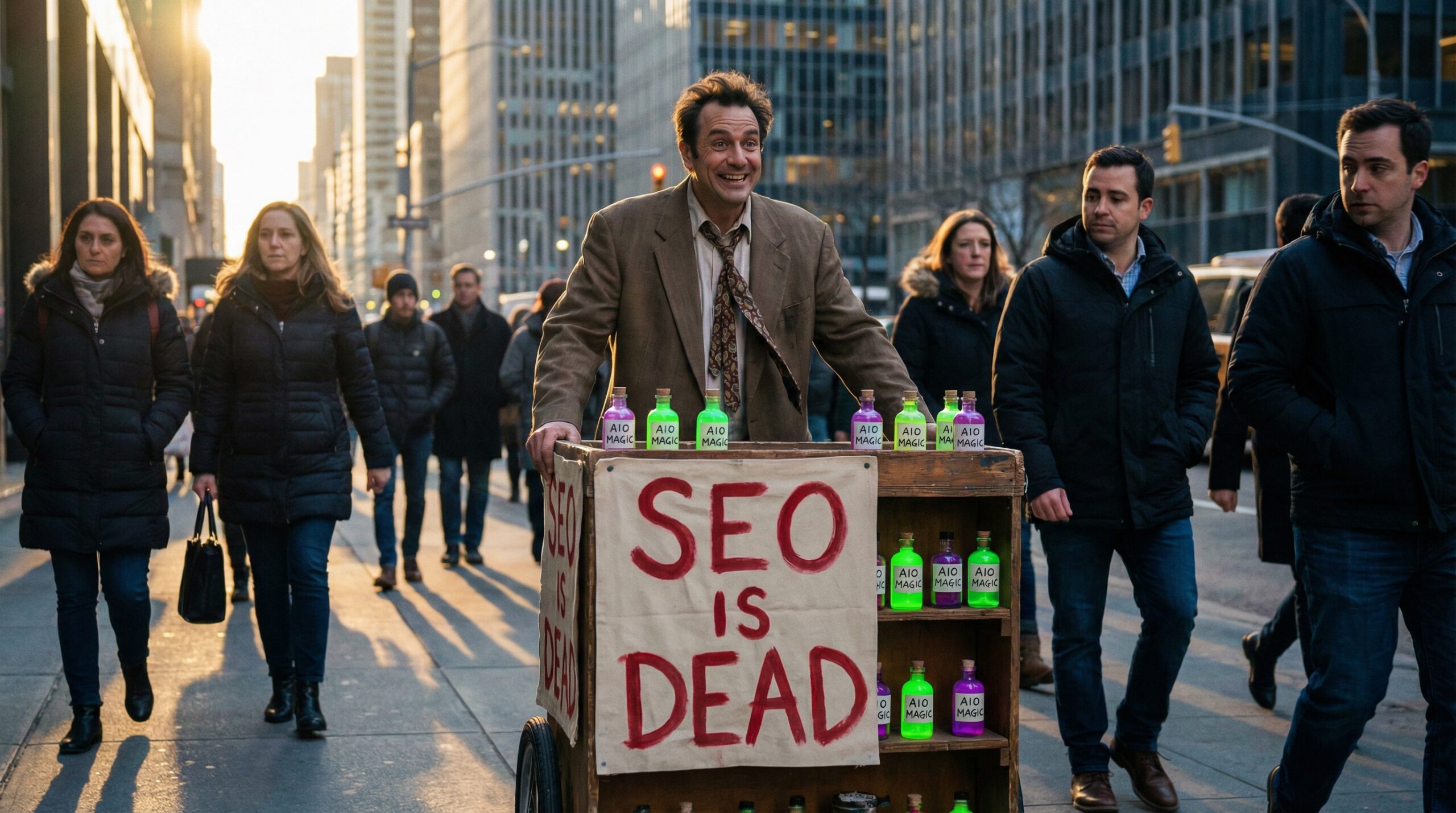

Either they’re lying to you, or they don’t know what they’re talking about. Either way, you should stop listening to them.
I know that’s a strong statement. I don’t care. I’ve spent 15 years in the SEO trenches and the last 3 years engineering AI systems — actually building them, not just prompting ChatGPT and calling myself an expert. And what I’m watching unfold across LinkedIn, Twitter, and the conference circuit right now is one of the most brazen cases of the blind leading the blind I’ve ever seen in this industry.
The claim is simple: SEO is dead, and AIO (or AEO, or GEO — pick your favorite acronym) is the future. Forget everything you knew. Start over. Buy my course.
Here’s the truth they don’t want you to hear.
AIO is just SEO.
The AI is performing the same web searches you would. It’s just doing it faster and summarizing the results. That’s it. That’s the revolution everyone is selling you. And if you understand what’s actually happening under the hood — which most of these “experts” demonstrably do not — you’d realize the entire premise of their argument collapses on contact with reality.
Let me show you exactly why.


The AI Isn’t Magic. It’s Running a Google Search.
Here’s the dirty secret that most self-proclaimed “AI experts” don’t know — or don’t want you to know, because it would collapse their entire thought-leadership brand overnight.
AI models do not have real-time access to the internet.
Full stop.
ChatGPT, Claude, Gemini — none of these models are browsing the web the way you browse the web. When an AI model needs current information, it activates what’s called a function call (also known as a tool call). It’s a feature built into the scaffolding around the model that executes a search query, retrieves results, and feeds that data back to the model so it can synthesize a response. As OpenAI’s own documentation explains, function calling is how models interact with external tools — including web search. The model doesn’t “know” what’s on the internet. It asks a tool to go look, and the tool brings back results.
That’s it. That’s the whole magic trick.
The AI is doing exactly what you would do if you Googled something. It’s just doing it faster, reading more results, and summarizing what it finds. The underlying mechanism is identical: a search query hits a search engine, results come back ranked, and those results get consumed. There is a dangerous gap between using AI and building AI, and it’s never been more visible than in this conversation.
So when someone tells you “AIO is replacing SEO,” what they’re actually telling you — without realizing it — is that search results still matter. They’re just being delivered in a different package by a different carrier.


The Data Is Brutal (If You’re in the “SEO Is Dead” Camp)
If the theoretical argument isn’t enough for you, let’s talk data.
Because the numbers don’t just disagree with the “SEO is dead” narrative. They embarrass it.
An seoClarity study analyzing 432,000 keywords found that 99% of AI Overviews cite at least one source from the top 10 organic search results.
Ninety-nine percent.
The AI isn’t going rogue and discovering hidden gems on page 47 of Google. It’s pulling from the exact same top-ranking results that traditional SEO has always targeted.
According to Authoritas research, the vast majority of AI Overview citations come from domains already ranking in the top 10 organically. If you’re not ranking, you’re not getting cited by AI either.
And a BrightEdge study tracking months of data found that the overlap between AI Overview citations and organic rankings has grown over time — trending from roughly 32% to over 54%.
Not slowing down. Not diverging. Accelerating.
Let me say this as plainly as I can: if you aren’t winning at SEO, you aren’t going to win at AIO. The data is overwhelming and it all points in the same direction. The AI is not bypassing search rankings. It’s leaning on them harder than ever.


“But My Traffic Is Down!” — Let’s Talk About That
Now, I can already hear the counterargument forming: “If SEO still matters so much, why is my traffic declining?”
Fair question. And it deserves an honest answer.
Yes, traffic is declining for many sites. That’s real. But the reason it’s declining matters far more than the fact that it is — and almost nobody is talking about the reason with any nuance.
Here’s what’s actually happening: the traffic you’re losing was mostly informational intent.
Think about it. When someone searches “what is the capital of France” or “how many ounces in a gallon,” they don’t need to visit your blog post. They never really did. They just needed the answer. And now an AI model is summarizing that answer before they ever click a link.
That’s not SEO dying. That’s low-intent traffic evaporating — traffic that, if we’re being honest, wasn’t particularly valuable to begin with. It inflated your analytics dashboard, sure. But it wasn’t driving revenue.
Purchase-intent queries are a completely different story.
When someone searches “best running shoes for flat feet” or “CRM software for small teams,” they’re not just looking for a quick summary. They want to browse product images. They want to compare features. They want to read reviews and see pricing pages. An AI summary might influence their shortlist, but it’s not replacing the experience of actually visiting a product page and making a decision.
Will purchase-intent traffic be impacted? Yes. To some degree, it will.
But not to the same degree. Not even close.
The people screaming “SEO is dead” are looking at a top-line traffic number going down and panicking without examining what kind of traffic they lost. If your entire SEO strategy was built on capturing informational queries that could be answered in a single sentence — you didn’t have an SEO problem. You had a content strategy problem.


The Real Reason People Want SEO to Be Dead
Now let’s talk about the other elephant in the room. Why are so many people so eager to kill SEO and crown AIO as the new king?
Because they’ve been losing at SEO for years.
That’s it. That’s the reason.
Many of the loudest voices proclaiming that “SEO is dead, long live AIO” are people who struggled with rankings, never quite cracked the code, and watched competitors outperform them year after year. AIO presents a tantalizing opportunity: a reset button. If the old game is “dead,” maybe they can get in early on the new game and finally win.
I get the appeal. I really do.
But there’s a difference between being excited about new opportunities and deliberately misrepresenting reality to justify your excitement. (And to be clear, that’s exactly what’s happening.)
Then there’s the other camp — the “AI experts” who couldn’t even tell you how the AI gets access to the web. They’ve never built an AI system. They’ve never looked at a function call schema. They’ve never configured a tool-use pipeline. But they used ChatGPT for six months and now they’re selling courses on AI Optimization as if it’s a brand new discipline. This is the AI education gold rush at its worst — people packaging surface-level knowledge as deep expertise and charging a premium for it.
Spoiler: it’s not.


There’s a name for this phenomenon: the Dunning-Kruger effect. People with limited expertise in a subject tend to dramatically overestimate their competence. And research from Aalto University found that AI has actually made this worse — AI-literate users show even greater overconfidence in their understanding of how these systems work.
People who use ChatGPT every day become more confident they understand how it works — while understanding less about the actual engineering under the hood. They experience self-fulfilling interactions that validate their assumptions. They ask the AI something, get a polished response, and think “See? It just knows things.”
It doesn’t just know things. It Googled it. Just like you would.
That’s confirmation bias running on rocket fuel.


Where AIO Is Slightly Different (And Why It Still Doesn’t Kill SEO)
I’m not going to pretend nothing has changed. That would be dishonest, and I don’t do dishonest.
There is a legitimate nuance worth understanding. When an AI model performs a search and synthesizes results, it’s typically scanning more results than a human would. You might look at the top 3-5 results on Google and call it a day. The AI might scan 10, 20, or even 50 results and then pattern match across all of them.
This is where it gets genuinely interesting.
The AI can identify themes and patterns that aren’t obvious if you only skim the first page. Content ranking at positions 5-20 might contain patterns that appear more frequently across the broader result set than what’s in the top 3. In theory, this could mean that “lower-ranking” content has outsized influence on the AI’s synthesized response. As the Women in Tech SEO research on AIO/GEO aptly notes, we need to separate facts from theories in AI search — and much of what’s being sold as AIO strategy is still firmly in the “theory” column.
But here’s what everyone conveniently skips past: even if all of that is true, it still means you have to be ranking in the top results — and across more results — for the AI to favor your content.
The bar isn’t lower. It’s higher.
You need to rank well across a broader set of queries, not just your primary keyword. That’s not “SEO is dead.” That’s “SEO just became the most important skill in your entire marketing stack.”


The Acronym Treadmill Needs to Stop
The industry has created an alphabet soup of acronyms — AIO, AEO, GEO, LLMO — that all describe the same underlying discipline with slightly different window dressing. Every single one depends on your content being discoverable, authoritative, and well-structured enough for search engines to surface it.
The distinctions between AEO, GEO, and LLMO are mostly semantic. They all build on the same SEO foundation.
Different labels. Same work.
Creating a new acronym doesn’t create a new discipline. It creates a new conference talk and a new course to sell. Why are experts so addicted to complexity? Because complexity is profitable. Simplicity doesn’t sell keynote slots.
Let’s stop pretending otherwise.


So What Should You Actually Do?
Enough tearing things down. Let’s build something up. If you want your content to perform well in both traditional search and AI-generated responses, here’s what actually matters:
- Keep doing SEO. Keyword research, quality content, technical optimization, backlinks — all of it still matters. The data proves it overwhelmingly.
- Aim for broader ranking coverage. Don’t just optimize for one keyword. Create comprehensive content that ranks across multiple related queries, because AI synthesizes across a wider result set than any human would scan.
- Structure your content for clarity. Clear headings. Concise answers. Well-organized information. This helps both search engines and AI models extract and cite your content.
- Build topical authority. AI pattern-matches across results. If your domain appears consistently across multiple related queries, you’ll have outsized influence on how the AI responds.
- Stop chasing acronyms. Focus on creating genuinely useful content that answers real questions. That’s been the playbook for a decade. It’s still the playbook today.
The fundamentals haven’t changed. The delivery mechanism has. Confusing those two things is exactly how you end up chasing trends instead of building something that lasts. Critical thinking is the only skill that matters now — in AI, in SEO, and especially in deciding who you take advice from.


The Bottom Line
SEO is not dead. Search results are just being delivered in a different package by a different carrier.
The mailman changed uniforms.
If you want AI to cite you, reference you, and favor your content — you need to rank. Period. And ranking is, has been, and will continue to be the domain of search engine optimization. Call it whatever acronym makes you feel cutting-edge.
The work is the same.
The people telling you otherwise either don’t understand how AI systems actually work, or they’re selling you something.
Probably both.


