
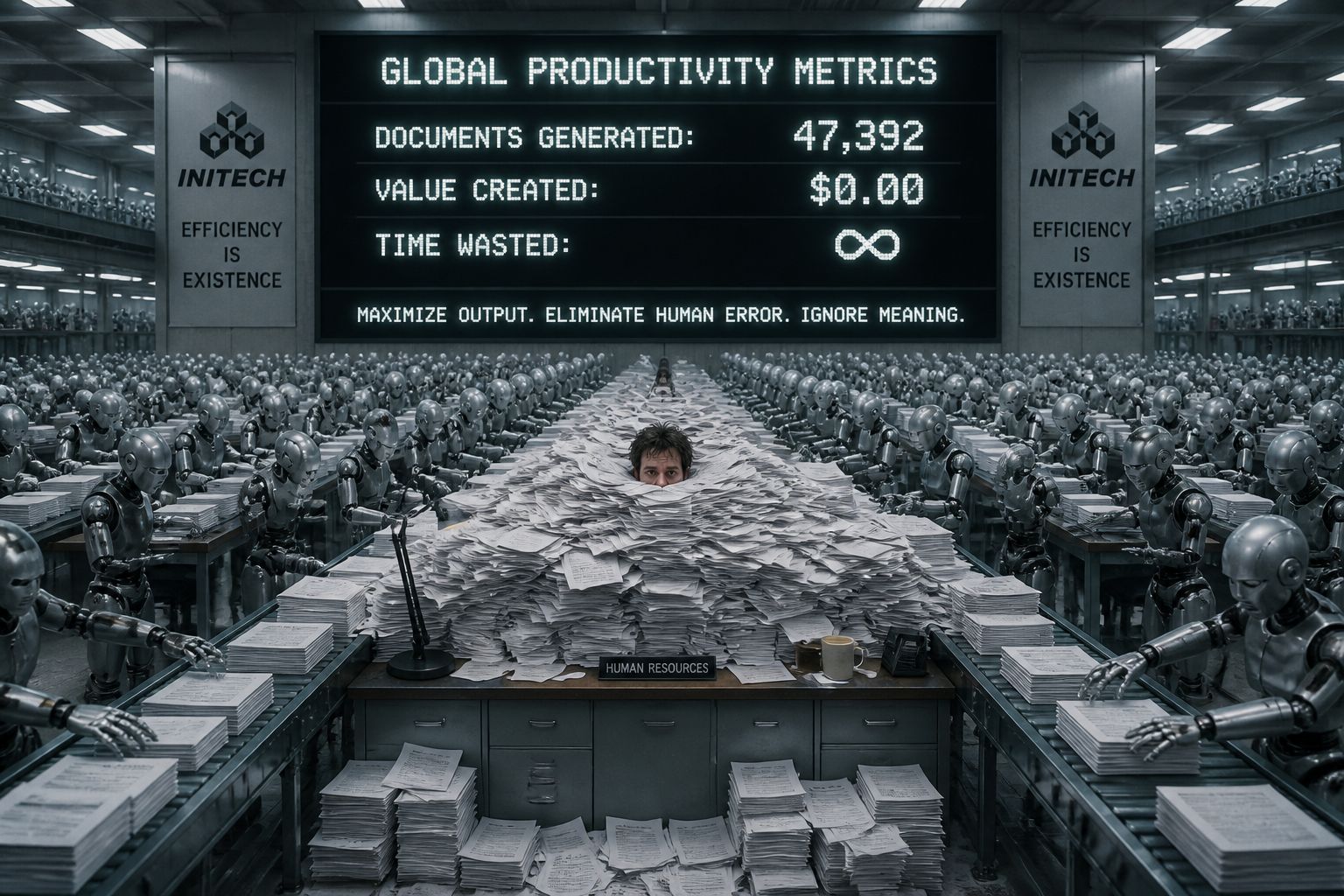

Somebody you follow online has an AI agent that writes four blog posts a day.
Fully researched. Cited sources. Embedded videos. Internal links. The whole production.
And every time they show it off, the comments fill up with the same breathless reaction.
“This is insane.”
“The future is here.”
“I need to build this immediately.”
Here’s the question nobody in that thread is asking: has a single one of those four-a-day blog posts ever made them a dollar?
Not “could it.”
Not “imagine the potential.”
Has it. Actually. Done. Anything.
Most of the time, the honest answer is no. And the person running the agent doesn’t know it, because they never thought to ask the question.
They’re not measuring value. They’re measuring volume. And those two things have almost nothing to do with each other.


We Fell in Love With the Wrong Thing
I want to be careful here, because I’m not anti-agent. I run an AI company. And we’re getting ready to release agentic AI features soon.
I use this stuff every single day. I’ve built things with AI that genuinely changed how I work.
But somewhere in the last couple of years, a lot of smart people lost the plot.
We stopped being interested in what AI accomplishes.
We got intoxicated by what AI can do.
Those sound like the same thing.
They’re not even close.
“What it can do” is a feature list. “What it accomplishes” is an outcome. One of those pays your bills. The other one just feels amazing on a Tuesday afternoon when you watch a swarm of agents run a workflow you built.
The research is starting to catch up to the feeling.
Earlier this year, UC Berkeley Haas researchers studied how AI was actually changing daily work at a U.S. technology company. They expected to find people getting time back. They found the opposite. AI didn’t free up workers’ time. It intensified the work. It expanded the scope of what people felt they should be doing. It stretched the hours longer.
Harvard Business Review published their findings under a headline that should stop you cold: “AI Doesn’t Reduce Work, It Intensifies It.”
Workday’s global research from January found the same crack in the foundation. The productivity gains are real. But they’re getting eaten alive by rework. Fixing mistakes. Rewriting weak output. Double-checking what the model produced.
So here’s the uncomfortable math. We adopted these tools to save time. We are now busier than we have ever been. And a huge percentage of that busyness is generating no measurable value whatsoever.
We didn’t automate our work. We invented new work and called it progress.


This Is the Same Mistake, Wearing a New Outfit
If this pattern feels familiar, it should. We just watched it play out with the whole vibe coding movement.
Everybody started spinning up apps in minutes on Loveable, Replit, Bolt, and v0. The thrill was real. The output was real. And most of those apps went exactly nowhere.
Why? Because the people building them were in love with the act of building. Not with solving a problem someone would pay for.
I compared it to sourdough starter for a reason.
Remember 2020? Everybody had a bubbling jar of fermented flour on their counter. Six months later, almost all of those jars were in the trash. The hobby was never about bread. It was about the feeling of doing something new.
Agentic AI is the same energy, scaled up and handed a bigger budget.
And that bigger budget is exactly the problem I dug into in The Automation Tax. Every agent carries a cost most people never put on the books.
Every token you burn. Every hour you spend babysitting a setup. Cost adds up.
The novelty is free. The reality has a price tag.
Which brings us to the deeper question underneath all of it.


The Psychological Trap Has a Name
There’s a reason this happens, and it isn’t because you’re lazy or stupid. It’s because your brain is doing exactly what brains do.
It’s a three-fold psychological distortion field. Three separate things that cause your brain to impair your critical thinking. Stack these well-documented biases on top of each other and you’ve got a perfect storm.
The Labor Illusion
The first thing is what psychologists call it the labor illusion. We assign value to things based on the visible effort behind them, not the actual result. When we watch an agent grind through twelve steps to produce a report, our brain registers that as valuable. Because look at all that work. The activity itself feels like the accomplishment.
The IKEA Effect
The second is the IKEA effect. We overvalue things we build ourselves. The more sweat we pour into an agentic workflow, the more we love it. And the less capable we are of judging whether it’s any good.
This is why many product creators have a hard time with their own business valuations. They spent 12 months building a product that exactly 17 people purchased and is producing $123 in MRR. And they are trying to sell the business for $100,000.
They think the effort they put in makes it more valuable than what it’s producing. They’re 123% wrong.
The Novelty Bias
The last is novelty bias. The human brain releases dopamine in response to new and unexpected stimuli.
AI is a novelty slot machine. Every new capability gives you a hit. Every new agent. Every new “holy cow, it can do THAT?” moment. You’re not chasing value. You’re chasing the next pull of the lever.
Put those three together and you get a familiar character. Someone who built a complicated thing (IKEA effect). Watched it do a lot of visible work (labor illusion). And felt a jolt of delight every time it did something new (novelty bias).
That person is convinced they’re being productive. They are emotionally incapable of seeing that they might be wasting their time.
I’m going to give that pattern a name, because naming a thing is how you start to defend against it.
Capability Intoxication: the state of being so enamored with what AI can do that you lose all ability to evaluate whether it should do it.
It’s a real condition.
I’ve had it.
You’ve probably got a mild case of it right now.


The Three Questions I Ask Every Single Time
I have a friend who sends me cool AI stuff constantly. A YouTube video about some agentic setup. A TikTok of someone’s autonomous research pipeline. A thread about a guy who wired up an open-source agent to run his whole content operation.
And somewhere along the way, I developed a reflex.
Every time one of these lands in my inbox, I ask the same three questions.
Not to be a jerk. To stay sane.
These questions are the antidote to capability intoxication. They drag you out of the dopamine loop and back into reality.
Question 1: What problem are you actually trying to solve?
Not “what can this do.” What problem does it solve.
If you can’t name the problem in one sentence, you don’t have a solution. You have a toy. And toys are fine, as long as you’re honest that that’s what you bought.
Most agentic setups I see online are answers in search of a question. The person built the thing because they could. Then they went looking for a reason to justify it.
Start with the problem. Always. If there’s no real problem, there’s no real value. There’s just activity.
Question 2: How much of this is novelty, and how much is genuine value?
Be brutally honest with yourself on this one.
When you fired up that agent for the fourth time today, were you solving something? Or did it just feel good to watch the machine go?
There’s no shame in playing. I play with this stuff for fun all the time. The danger comes when you mistake the play for work. When the thrill of using AI becomes indistinguishable from the value of using AI, you’ve lost the thread.
Ask yourself what percentage of your AI activity this week was novelty. And what percentage was outcome. If you’re being honest, the number will probably scare you a little.
Question 3: How do you measure whether the value is worth the cost?
This is the one nobody wants to answer.
Every token has a price. Every hour you spend building, babysitting, and fixing an agent has a price too. And your time is the most expensive resource you own.
So what’s your measurement? How do you know the value coming out exceeds the cost going in?
If you don’t have an answer, you don’t have a business process. You have a hobby with a subscription fee.


Drill Deeper: The Questions Behind the Questions
Those three are the entry point. But if you really want to expose what’s happening, you have to go a layer deeper. These are the follow-ups I work through, especially when someone’s bragging about their agentic empire.
What your agents are actually doing
Make a list. Write down every task you’re currently handing to your agentic AI.
Now, next to each one, answer this: what does that task translate to in terms of value? What value does it bring you personally? What value does it bring your business or your work? What is the direct, traceable thing it delivers?
Stare at each item. If you can’t draw a straight line from the task to a real outcome, you’ve found your busy work. Highlight it. That’s a candidate for the chopping block.
Whether the work needed to exist at all
Here’s a distinction that changes everything. For each task your agents handle, ask which bucket it falls into.
- Replacement work. Things you were already doing yourself, that genuinely needed doing, and now you’ve handed off. This is the good kind. This is real leverage. You had a job. The agent does the job. You got time back.
- Invented work. Things you would never have done at all if AI couldn’t do them. The four blog posts a day. The autonomous research reports nobody reads. The summaries of summaries.
Replacement work creates leverage. Invented work creates the illusion of leverage.
Most of what people are so proud of falls into bucket two. They’re not saving time on things that mattered. They’re spending time and money on things that never needed to happen in the first place.
That’s not productivity. That’s a very sophisticated way to look busy.
On proving the ROI
Let’s go back to our friend with the four blog posts a day. Fully researched, cited, video-embedded, the works.
I have one set of questions for him. And they’re not hostile. They’re just honest.
- How has that improved your traffic?
- Have you gotten more sales?
- Have those posts generated a single qualified lead?
- What does the traffic data actually show?
- What does the lead data actually show?
- How are you proving the ROI?
Because here’s the truth, and I’ll say it plainly: most people running these setups are spending more on their agents than the agents are producing. They’ve automated the creation of content that nobody asked for, nobody reads, and nobody remembers.
They feel like they’re winning.
The spreadsheet, if they ever bothered to build one, would tell a very different story.


The Honest Audit Framework
Talk is cheap. So let’s get practical.
Here’s a framework for taking an honest look at what you’re doing with AI agents. And deciding what to keep, kill, or build.
I call it the VALUE audit. Five questions, one per letter. Run every agent and automation through it.
V: Verify the problem
State the specific problem this agent solves in one sentence. No problem, no agent. If you can’t articulate it cleanly, you’ve already failed the test.
A: Assess the alternative
What would happen if this task simply didn’t get done? If the answer is “nothing meaningful,” you just found pure busy work. Kill it. Not everything that can be automated deserves to exist.
L: Locate the value
Draw the line from the agent’s output to a real outcome. Revenue. Saved hours on work that mattered. Reduced error rates. Customer retention. If you can’t trace the line, there’s no value to locate.
U: Understand the true cost
Add it all up. Token costs. Subscription fees. The hours you spent building it. The hours you spend babysitting and fixing it. Time is the line item people always forget. And it’s usually the biggest one.
E: Evaluate the ratio
Put value on one side and cost on the other. If value doesn’t clearly exceed cost, you have your answer. Fix it or kill it.
Run your whole operation through this. I promise you’ll find agents you’re proud of that deserve to be shut down today.


What Integrative AI Actually Looks Like
I want to be clear that the answer isn’t to retreat. The answer isn’t to abandon AI and go back to doing everything by hand like it’s 2018.
The answer is to use AI the way it’s actually meant to be used. As an amplifier of your expertise, not a replacement for your judgment. That’s the difference between the people quietly winning and the AI cargo cult performing the rituals of productivity without ever landing the plane.
The people getting real returns aren’t the ones with the most agents. They’re the ones who picked the right problems. They found work they were genuinely doing. Work that genuinely mattered. And they used AI to do it faster and sharper without losing the human element that made it valuable in the first place.
That’s the whole game. Pick a real problem. Apply AI to it. Measure the result. Keep what works. Kill what doesn’t.
It’s not sexy. It won’t get you a viral thread. But it’ll make you money instead of costing you money. That’s a trade I’ll take every time.
Stop Counting What You Can Do. Start Counting What It’s Worth.
Here’s where I’ll leave you.
The most dangerous thing about AI right now isn’t that it’ll take your job. It’s that it’ll seduce you into mistaking motion for progress.
You can build a hundred agents. You can automate a thousand tasks. You can generate a million words a month. And at the end of the year, you can stare at your bank account and realize that all that incredible capability accomplished nothing that mattered.
Capability is not value. Activity is not achievement. Volume is not impact.
So before you build the next agent, before you share the next “you won’t believe what I automated” post, run the audit. Ask the three questions. Be honest about the answers.
Then ask yourself the only question that’s ever really mattered: what problem am I actually trying to solve?
If you can answer that one cleanly, you’re already ahead of almost everyone.


